-
E-mail
ruideyq@163.com
-
Phone
13013115308
-
Address
Double Innovation Foundation of Southeast University National University Science and Technology Park, Ma'anshan City, Anhui Province
Product Categories
Anhui Ruide Instrument Equipment Co., Ltd
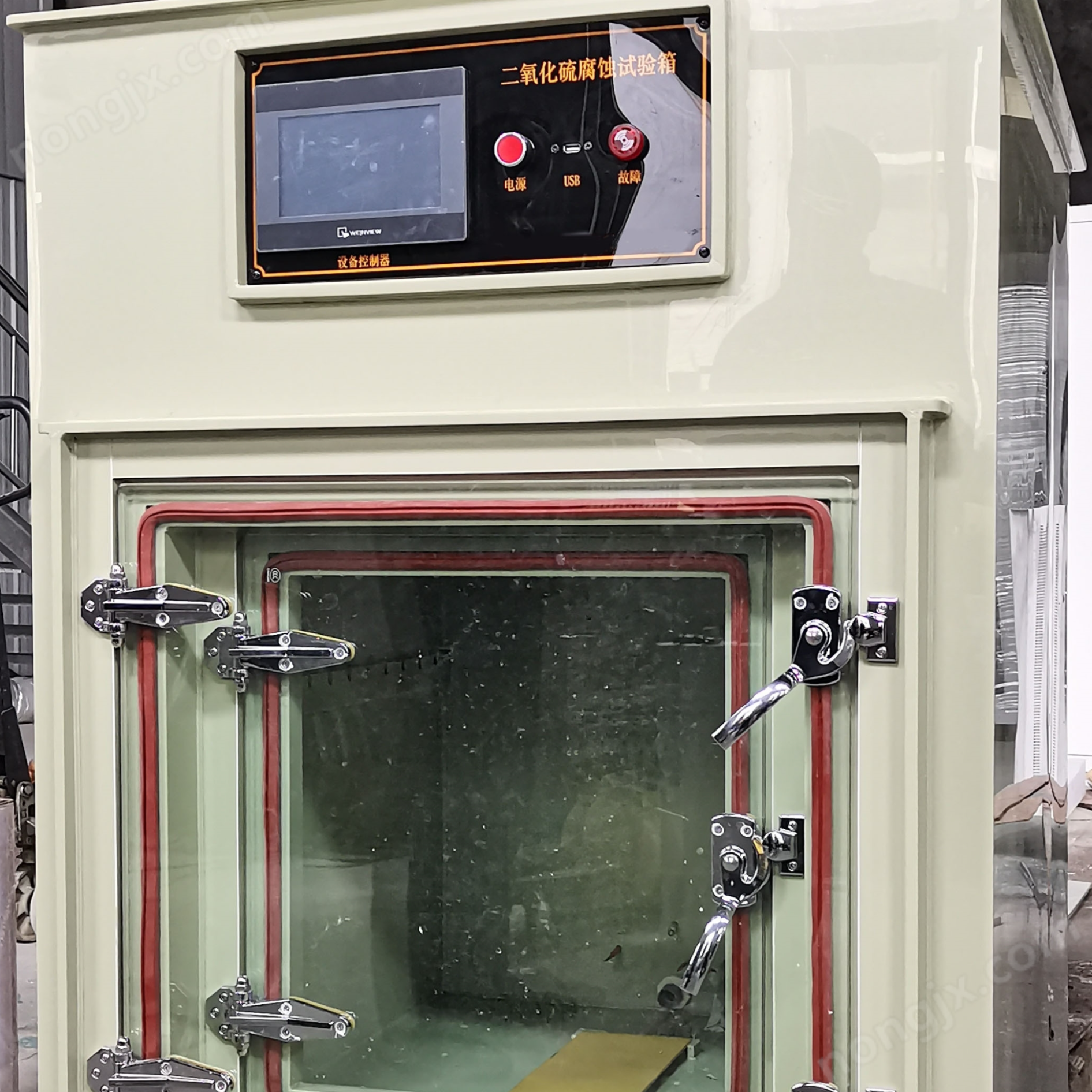

Price for supplying sulfur dioxide corrosion test chambers
NegotiableUpdate on 01/17
- Model
- Nature of the Manufacturer
- Producers
- Product Category
- Place of Origin
Overview
The intelligent low concentration sulfur dioxide corrosion test chamber uses sulfur dioxide gas to accelerate the corrosion of materials or products in a certain temperature and relative humidity environment, reproducing the degree of damage suffered by materials or products within a certain time range. Equipment can be used to assess the ability of materials and their protective layers to resist sulfur dioxide corrosion, as well as to compare the process quality of similar protective layers. It can also be used to assess the ability of certain products to resist sulfur dioxide corrosion.
Product Details
This sulfur dioxide testing equipment is designed and manufactured in accordance with GB 2423.19-81, "Sulfur Dioxide Corrosion Test for Contact Points and Connectors" standards, and is suitable for corrosion testing with sulfur dioxide and hydrogen sulfide gases.
Intelligent low concentration sulfur dioxide corrosion test chamberUsing sulfur dioxide gas to accelerate the corrosion of materials or products in a certain temperature and relative humidity environment, reproducing the degree of damage suffered by materials or products within a certain time range. Equipment can be used to assess the ability of materials and their protective layers to resist sulfur dioxide corrosion, as well as to compare the process quality of similar protective layers. It can also be used to assess the ability of certain products to resist sulfur dioxide corrosion.
The equipment can reach any temperature point between 10 ℃ and 50 ℃ in the experimental workspace and maintain a constant temperature. Continuously introduce a certain concentration of sulfur dioxide gas into the box with a specified volume, and conduct corrosion tests on materials or products while maintaining a constant concentration, temperature, and relative humidity.
The material used to manufacture this equipment is corrosion-resistant imported PVC plastic sheet, which does not react with sulfur dioxide, does not absorb sulfur dioxide, and does not affect the test results. In the design work of this equipment, the internal and external pressures are balanced, and the mixed gas flows uniformly inside the box. Moreover, the design takes into account the generation of condensation water at the top, inner walls, and other parts of the equipment. Therefore, the top of the box is designed with a 120 degree angle, so that condensation water will not drip onto the sample during the testing process and affect the test results.
The appearance design of the sulfur dioxide (hydrogen sulfide) corrosion test chamber is beautiful, the structure is reasonable, and the lines are smooth and natural. The material of the outer shell of the box is imported PVC plastic sheet, which has a smooth and bright appearance without scratches, corrosion resistance, easy cleaning, and no leakage. The inner liner is made of the same PVC plastic sheet, with a temperature resistance of 60 degrees. All kinds of auxiliary accessories and facilities are also corrosion-resistant, with reasonable structural design.
The oversized box door is made of tempered glass and sealed with corrosion-resistant silicone rubber, which is also corrosion-resistant, easy to clean, and leak free. During the experiment, the indoor test conditions can be clearly observed from the outside without affecting the test results. The box door and body are sealed with corrosion-resistant silicone rubber to prevent sulfur dioxide (hydrogen sulfide) from overflowing, which may affect the test results and corrode other equipment in the room, and even cause harm to the test operators.
The box heats up quickly and the temperature and humidity are evenly distributed. The sample rack is designed according to national standards and can also be hooked. After coming out of the steel cylinder, sulfur dioxide (hydrogen sulfide) gas is depressurized and then controlled by a corrosion-resistant solenoid valve to enter the diversion pipeline at the bottom of the box through a flow meter. It is evenly mixed with the air inside the box, and the concentration can be detected and controlled by a sulfur dioxide (hydrogen sulfide) concentration detector.
The refrigeration system of the equipment is installed on the left side of the equipment, mainly for cooling and dehumidification purposes.
Intelligent low concentration sulfur dioxide corrosion test chamberThe control system is designed on the right side of the box and is easy to operate. The specially designed sulfur dioxide gas filtration device can quickly and effectively filter the residual sulfur dioxide (hydrogen sulfide) gas in the box after the experiment is completed, and the residual gas will not cause pollution to the atmosphere, making it easy to operate.
Main technical specifications and parameters of the equipment
Specifications Studio dimensions D * W * H External dimensions D * W * H Power
RD- DSO2-300 600×550×900 850×900×1700 3.0kW
RD- DSO2-600 850×750×940 1000×1100×1800 4.0kW
RD- DSO2-900 1000×900×1000 1300×1250×1900 6.5kW
1. Temperature range: 10 ℃ to+50 ℃
2. Relative humidity: (60% -95%) ± 5% R? H
3. Temperature uniformity: ≤± 2 ℃
4. Temperature fluctuation: ± 0.5 ℃
5. Test time: 0-999 H, M, S adjustable
6. Sulfur dioxide concentration: 10-30PPM (adjustable)
7. Sulfur dioxide gas generation method: steel cylinder method
8. Sulfur dioxide concentration measurement method: controlled by a sulfur dioxide concentration detector
9. Sample rack: meets standard requirements
10. Operating environment temperature: 10 ℃~35 ℃
11. Operating environment humidity: ≤ 85%;
12. Power Requirements: AC 220V 380V
Test box structure
Both the inner and outer shells are made of imported PVC plastic sheets, which are molded through special molds and softened at high temperatures before being cooled. The seams between the sheets are milled to form a 90 degree right angle, and the plastic welding wire is melted using a high-temperature welding gunfusion splicingThe method of cooling makes the weld seam more solid, the seams of the entire box are smooth and flat, the box structure is compact, and the appearance is shiny,
The temperature and humidity inside the box are controlled by an external temperature and humidity air conditioning cabinet to create a specified temperature and humidity environment that enters the box and circulates inside the box. A set of air conditioning system is designed for the equipment, which includes a refrigeration system, a heating system, and a humidification system. The air conditioning system is manufactured to meet the temperature and humidity requirements of the test. After being stirred evenly in the mixing chamber between the inner and outer shells of the equipment, it enters the box and inputs a certain concentration of sulfur dioxide gas. The flow rate is controlled to reach the specified range, and the concentration can be detected by a sulfur dioxide concentration detector. The equipment heats up quickly and the temperature and humidity are evenly distributed. The heating and humidification element adopts titanium metal heating tubes, which are corrosion-resistant and have a long service life. The box door is made of tempered glass, making it easy to open and close. Using corrosion-resistant silicone rubber seal to ensure that gas does not overflow. The design of the sample frame structure follows national standards and can also use hooks, which have a large load-bearing capacity and are easy to place the test samples. After coming out of the steel cylinder, sulfur dioxide (hydrogen sulfide) gas is depressurized and then controlled by a corrosion-resistant solenoid valve to enter the diversion pipeline at the bottom of the box through a flow meter. It is evenly mixed with the air inside the box, and the concentration can be detected and controlled by a sulfur dioxide (hydrogen sulfide) concentration detector. Equipped with over temperature protection and low water level warning to ensure safe use.
The refrigeration system of the equipment is installed at the bottom of the equipment, mainly for cooling and dehumidification purposes.
The equipment control system is designed on the right side of the box and is easy to operate. The specially designed sulfur dioxide gas filtration device can quickly and effectively filter the residual sulfur dioxide gas in the box after the experiment is completed, and the residual gas will not cause pollution to the atmosphere, making it easy to operate.
control system
1. Temperature and humidity controller: Weilun Tong "," Fuji ", imported from South Korea" Sanyuan "high-precision digital temperature controller, with precise and stable control, and long-term operation without drift.
2. Sensor: PT100 test sensor
3. Time relay: 1s~9999h, m, s adjustable;
4. Execution components: Schneider AC contactors, small relays, solid-state relays
Refrigeration and dehumidification system
1. Compressor: 1 set of fully enclosed French Taikang;
2. Cooling method: air cooling;
3. Refrigerant: R404;
4. The entire system pipeline undergoes a 48 hour leak detection test with ventilation and pressurization;
5. The heating and cooling systems are independent;
6. Internal spiral refrigerant copper tube;
7. Slope evaporator;
8. The dry filter, refrigerant flow window, repair valve, oil separator, solenoid valve, and storage tank are all imported original parts.
execution standard
This sulfur dioxide testing equipment is designed and manufactured in accordance with GB 2423.19-81, "Sulfur Dioxide Corrosion Test for Contact Points and Connectors" standards, and is suitable for corrosion testing with sulfur dioxide and hydrogen sulfide gases.
protection system
Overall equipment overheating, fan overheating protection, overall equipment under phase/reverse phase, refrigeration system overload, refrigeration unit overpressure, overall equipment timing, other protections such as leakage, operation indication, automatic shutdown after fault alarm.
random data
Equipment qualification certificate, warranty card, packing list, equipment user manual, instrument and personal appliance user manual, equipment electrical schematic diagram, random spare parts, vulnerable parts, etc
Delivery Instructions
The supplier is responsible for delivering the goods to the customer's doorstep, introducing installation and debugging operations, until the customer's employees operate independently. The quality warranty period is one year, starting from the date of installation and acceptance. The supplier promises to provide spare parts for life. If after-sales service must be provided on-site, the supplier will arrive at the site within the customer's time.
Similar Product Recommend


