09,14,2026 5 views
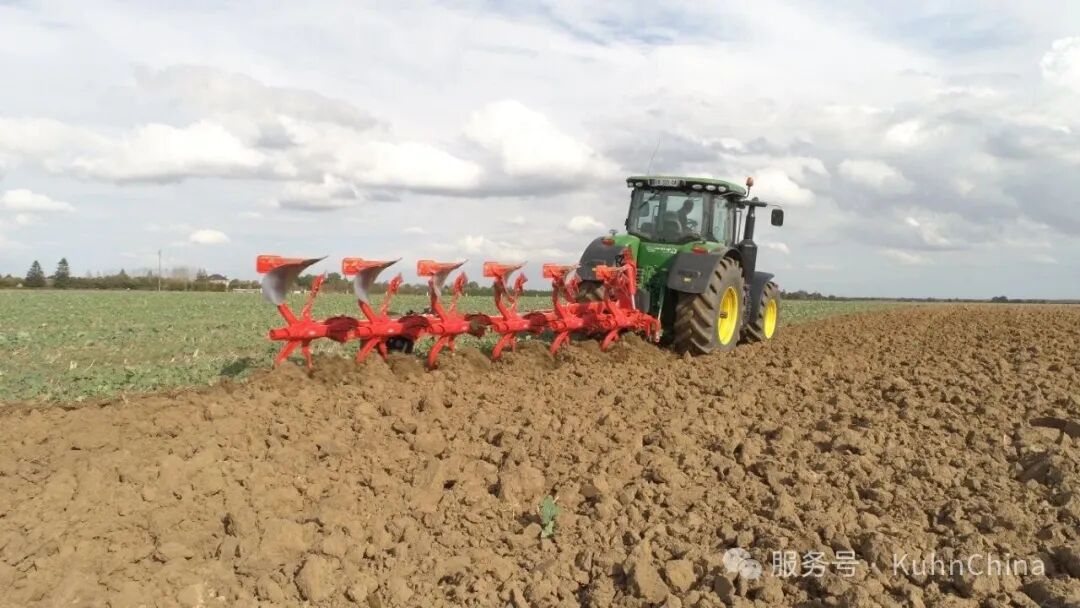
Plowing, a farming method, was first born during the agricultural revolution in the Middle Ages. Its core function was to bury manure into the soil layer in order to increase crop yields. Today, a considerable proportion of arable land worldwide still uses plowing operations in daily production. In 2023, 40% of Europe's arable land will still retain plowing practices. Despite the gradual popularization of simplified farming techniques and no till technology in recent years, plowing remains an irreplaceable and important means of production for farmers. It has many irreplaceable advantages in crop management, especially in providing strong support for reducing the use of plant protection agents. Of course, there are also certain shortcomings in the plowing operation itself, and the core to solving these problems has never been to completely abandon plowing, but to master scientific and reasonable operation norms.
In order to help you truly use plowing correctly and effectively, Kuhn has recently released the white paper "Practical Guidelines for Modern Plowing Operations". Next, our official account push will gradually interpret the core content of this white paper, and combine the field test data around the world to analyze the agronomic logic behind plowing, practical pit avoidance techniques and other practical information for you. Today, as the first installment of the series, we will start with "when and under what circumstances plowing is needed" to help you break free from the cognitive misconceptions of "plowing is omnipotent" or "plowing is useless" and establish a rational farming approach that is suitable for your own land.
Rationally view plowing land
In the modern agricultural cultivation system, plowing has long been regarded as the core agronomic method for improving soil and treating straw. However, with the changing planting environment and the popularization of sustainable agriculture concepts, the cultivation method relying solely on plowing is gradually becoming limited. Based on Kuhn's field testing and agronomic research findings around the world, we can maximize the advantages of plowing while minimizing its negative impacts through complementary agronomic solutions.
Fr é d é ric Moigny, a French agricultural expert in Kuhn, emphasized that "if we want to build a truly resilient agricultural production system, we must learn to combine different farming techniques and crop rotation schemes, rather than sticking to a single farming method
There are clear boundaries for the applicability of plowing under different field conditions:
In marginal plots with extremely poor soil conditions and weak soil fertility, blindly plowing is even less effective than not plowing, as plowing may further damage the already fragile soil structure.
In environments with high soil moisture, powerDrive rakeIt is a more secure alternative choice. This type of tool will not form a plow bottom layer that hinders the planting of crop roots, and can maintain soil permeability while ensuring the effectiveness of land preparation.
Regions with consistently arid climates are also not suitable for frequent plowing, as plowing can accelerate soil moisture loss through evaporation, further exacerbating the water scarcity pressure on the land.
Jean Fran ç ois Vian, a senior agricultural consultant at Kuhn, specifically pointed out that there are many one-sided farming misconceptions in the current agricultural circle, and many erroneous information have trapped farmers in fixed farming models, even leading them into production dead ends. Plowing has never been a black-and-white choice. It should always be a tool that farmers use wisely and on demand. As long as it is operated under suitable conditions, plowing can solve a large number of practical agricultural problems with lower economic and ecological costs. The core key is not whether to plow or not, but to control the frequency and intensity of plowing, and accurately control the working conditions of each plowing operation. Before starting heavy farming operations such as plowing, farmers must first conduct a complete diagnosis and evaluation of the land situation, and must not blindly follow the trend
In accordance with the requirements of the European Union's Common Agricultural Policy (CAP) and relevant guidelines for farmland protection in China, safe plowing operations can refer to these practical guidelines:
Try to choose a time when the soil is in a suitable dry and humid state for operation, and avoid the formation of plow bottom layer from the source. If deep soil compaction has already occurred, it can be used in conjunction with itDeep loosening machineCarry out targeted processing.
For plots with steep slopes, low clay content, and weak erosion resistance, plowing operations should be avoided as much as possible to reduce the risk of soil erosion.
√ It is strictly prohibited to carry out any farming operations when the soil is flooded or in a waterlogged state.
During the highly sensitive period of soil on sloping farmland from December 1st to February 15th of the following year, plowing along the slope is prohibited; If it is necessary to work, the vertical slope operation method of equal height tillage must be adopted, or a vegetation buffer zone with a width of not less than 5 meters must be set at the bottom of the slope.
For us growers, the core inspiration of this farming approach is not to completely negate the value of plowing, but to break away from the extreme perception of "plowing is omnipotent" or "plowing is useless", and combine different agricultural machinery tools such as plowing, driving harrows/tillage, and deep loosening machines with agricultural methods such as crop rotation and covering planting to create personalized farming plans that are suitable for your land conditions, ultimately achieving multiple goals of stable production, land protection, and cost reduction.