-
E-mail
444861877@qq.com
-
Phone
13641972652
-
Address
No. 253 Yulu, Jiading District
Ankerui Electric Co., Ltd
Design and Application Analysis of Energy Consumption Online Monitoring System for Coal Mining Enterprises
Date: 2025-05-29Read: 50
Design and Application Analysis of Energy Consumption Online Monitoring System for Coal Mining Enterprises
Jiangsu Ankerui Electric Appliance Manufacturing Co., Ltd. Jiangyin 214405, Jiangsu
Abstract:Coal mining enterprises not only provide core driving force for the development of the national economy, but also consume a large amount of energy. The national strategy of "dual carbon" poses challenges to coal mining enterprises' production, but also provides opportunities and driving forces for their technological upgrading, energy conservation and efficiency improvement. The dual control of energy consumption is the only way to achieve the "dual carbon" goal, and online monitoring, fine management, and scientific decision-making of energy consumption and carbon emissions in coal mining enterprises are the basis for achieving the dual control of energy consumption, energy conservation, and efficiency improvement.
Keywords:high energy-consumption; Dual control of energy consumption; Big data collection; Energy consumption accounting; digital transformation
0. Introduction
According to the 14th Five Year Plan for National Economic and Social Development and the 2035 Long Range Objectives Outline, the carbon peak and carbon neutrality routes have been planned and deployed. Various industries have successively proposed goals and implementation plans for carbon peak and carbon neutrality, and "30, 60" has also become a guiding goal for coal and other energy production enterprises.
The "Code for Green Mining Construction in the Coal Industry of the Ministry of Natural Resources" requires all mining enterprises to establish an energy consumption accounting system for the entire mining production process, control and reduce unit product energy consumption, material consumption, water consumption, and reduce "three wastes" emissions by adopting energy-saving and emission reduction measures. The Shaanxi Provincial Development and Reform Commission and the Department of Ecology and Environment also require all mining enterprises to enhance their energy statistical monitoring capabilities, improve their energy statistical monitoring and measurement systems, and strengthen the construction of energy consumption online monitoring systems for energy using units in accordance with the "Shaanxi Provincial Green Mine Management Measures" and the "Notice on Promoting the Construction of Energy Consumption Online Monitoring Systems for Energy Using Units".
1. Overview
In documents such as the "Dual Carbon" Work Action Plan (Interim) of Shaanxi Coal Industry, it is required that all units improve the level of energy conservation management informatization, carry out the construction of energy consumption online monitoring systems, apply information technology to promote environmental protection and energy management and energy conservation and consumption reduction work, deeply explore the energy conservation and emission reduction space in the production process, and ensure the achievement of phased energy conservation goals.
Based on the requirements of Shaanxi coal industry, taking the current development status of the industry as the background, the demand of various mines as the entry point, and the goal of effectively solving problems, while responding to relevant national policies, we have developed an online monitoring and management platform for energy conservation, environmental protection, and energy consumption to help enterprises monitor and manage energy consumption online, timely prevent pollution emissions, avoid excessive emissions, meet various environmental protection requirements, improve operation and maintenance efficiency, and gradually achieve clean production.
The production of coal mining enterprises itself is a complex system, with a long production chain, multiple energy consuming equipment, and various types of energy consumption, resulting in a large amount of industrial "three wastes". Currently, coal mining enterprises focus on intelligent transformation of the production process, and there is a slight lack of investment in energy consumption supervision.
This article is based on the actual situation of the mining area to build an energy consumption supervision system. Through the implementation of this system, all energy data in the entire mining area is monitored, measured, managed, analyzed, and predicted. A historical database of energy record data such as water, electricity, heat, diesel, etc. for various departments and energy consuming equipment in the entire mining area is constructed, and the relevant data is uploaded to the joint-stock company and provincial and municipal platforms.
2. Research direction and content
2.1 Real time measurement and statistical management of energy consumption units
This study will collect real-time energy consumption information from energy consuming units or high consumption equipment at all levels, and automatically complete functions such as measurement, recording, statistics, and customized reports. Manage the energy consumption of the entire mining area in a hierarchical manner according to high energy consuming equipment, important processes, office buildings, and energy consuming units at all levels.
2.2 Building a data model for real-time warning
Building digital energy consumption and efficiency models for important equipment, important processes, and energy consuming units at all levels, combined with effective output data, conducting year-on-year, month on month, and benchmarking analysis to achieve energy consumption warning.
2.3 Establish data support for energy-saving technological upgrades
Based on long-term energy consumption monitoring data, an energy big data diagnostic report is finally formed, combined with the production process of the entire mining area, to provide strong data and decision support for medium - and long-term energy-saving technological transformation plans.
2.4 Basis for establishing energy consumption management indicators
Under the policy of fine management, consumption reduction and efficiency improvement, establish a sound basis for energy consumption quantification management data for coal mining enterprise management.
2.5 Energy consumption management decision analysis
By accumulating data over a certain period of time, analyzing and predicting energy consumption from different perspectives, providing decision support for preventing energy waste, reducing energy consumption, and planning energy use rationally.
2.6 System Management and Information Release
Quickly and accurately provide various energy consumption data information, which can be uniformly released through an intelligent comprehensive control platform.
2.7 Integration with various platforms
Corresponding interfaces can be provided to achieve seamless integration with the provincial energy management platform.
3. System functional architecture design
3.1 System design principles
The system adopts a mode of decentralized collection, comprehensive monitoring, and centralized management. The system design follows principles such as reliability, compatibility, standardization, economy, and scalability.
The principle of energy consumption data collection is:
The overall gateway for various types of energy, which refers to the allocation of important energy consuming units.
Energy consuming units or equipment that are of significant importance in energy consumption statistical analysis. In the case of open data interfaces, measurement data should be collected from existing systems as much as possible to reduce investment costs.
3.2 System Network Architecture

Figure 1 Overall architecture diagram of the system network
The monitoring points of the energy consumption online monitoring and management system are distributed in different locations within the mining area, with a wide and scattered distribution range. Based on the above characteristics, the system network structure adopts a distributed structure, with a fiber optic ring network as the backbone network (some using existing 4G networks) and star shaped electrical connections to various subsystems. The system is connected to detection equipment through fieldbus or I/O mode.
The system adopts B/S (browser/server) mode. The management application server is connected to the database server through an Ethernet switch, and through networking with the information management system network, it supports seamless integration with the energy consumption platform of the joint-stock company, the provincial and municipal supervision platform, and the comprehensive control platform of the mining area, and supports remote customer browsing and access.
The system management layer implements energy data collection, storage, analysis, and calculation according to the needs of mining energy consumption monitoring and management. It provides business functional modules such as energy consumption statistics, energy consumption warning, year-on-year/month on month analysis, energy flow charts, energy dashboards, and energy reports. In addition, it also develops system management, information settings, energy system modeling, and other system functional modules, while achieving seamless integration with the joint-stock company platform and provincial platform.
3.3 System Software Addition and Functionality
Figure 2 System Software Architecture Diagram
The energy consumption online monitoring and management subsystem collects, stores, analyzes, and calculates energy data from the perspective of the entire mine organizational structure, various production processes, and energy consumption equipment. It provides business functional modules such as energy consumption statistics, energy consumption warning, year-on-year/month on month analysis, energy consumption analysis, benchmarking analysis, energy flow chart, energy dashboard, energy report, etc. for management personnel. In addition, there are system management, information settings, energy system modeling, and other system functional modules.
Edge data collection layer: mainly responsible for collecting various energy consumption data and effective output data. The edge collector needs to support common industrial communication interfaces and protocols downwards, and support cloud platform data communication protocols upwards.
Data platform layer: mainly responsible for data storage, classification, calculation, etc. Business application layer: mainly responsible for the statistics and analysis of various energy information, including energy consumption statistics, energy consumption analysis, energy consumption warning, benchmarking analysis, comprehensive report management, data query, etc.
4. Main functions of the system
4.1 The main functions of the information management layer are as follows
Planning and scheduling. Implement production planning, equipment and spare parts planning management. Provide interfaces with Shaanxi Coal Group's layer system to achieve system integration.
Energy efficiency management. Meet the needs of enterprises and achieve energy efficiency management.
Equipment management. Meet the needs of enterprises and achieve equipment management. It mainly includes the management of basic information, operation information, operation records, warnings, faults, etc. of production equipment and measuring equipment.
Power indicator management. Mainly includes the management of power control indicators.
Comprehensive report management. It can automatically generate the required reports according to the needs of the enterprise, or customize pages and edit reports according to its own needs. The report mainly includes various standardized reports related to energy and power, including various production and consumption reports.
Comprehensive management. Mainly including graphic management, process management, system management, data management, user management, permission management, shift handover management, production management, assistance management, etc.
WEB release. Realize information sharing in energy management.
The main functions of the centralized monitoring layer are as follows:
Dynamic graphic monitoring: Set up dynamic process flow screens and single host process screens, display graphic animations, real-time display of station number parameters and equipment operating status. For subsystems with a wide range of involvement, multiple screens can be set up.
Real time data monitoring: Based on the display of data on the process flow screen, a grid format is implemented to summarize and display various process parameters and equipment status in real-time. The grid background color should be distinguished according to the classification of the displayed data, making it clear at a glance for operators to centrally monitor the system status.
Remote operation: remotely control all devices, operate on-site devices (start/stop) and electric valves (open/close) through a mouse, and set password protection according to permissions.
Warning and alarm function: For parameter over limit alarm and equipment failure alarm, sound and light prompts are issued, real-time command printing is possible, with Chinese prompts and automatic recording. The alarm is treated differently based on the urgency and level of the accident, distinguished by different alarm prompts and colors. And establish a maintenance mode to ensure that the automatic alarm function can be turned off during maintenance and testing.
Real time trend chart: Real time display of the changing trends of various process parameters, such as flow rate, temperature, pressure, current, frequency, etc., which helps operators and managers to grasp the changes in production process parameters in real time;
Report: Set up class reports, daily reports, monthly reports, and annual reports, and print them in real-time according to classification and summary reports. The report settings can be adjusted according to needs, and the filtering and calculation formulas and function parameters of the report data can be adjusted at any time based on actual needs and temporary changes.
Data collection, storage, recording, and publishing: The system has the functions of collecting, storing, and recording various process parameters, equipment status, and measurement data. Various information is written into real-time historical databases or management databases according to different functional requirements, for use by energy management system software. The system monitoring screen and related information can be published through WEB for easy access and remote browsing by management personnel through the network.
System management: Unify the security operation permissions of operators, maintenance engineers, energy management personnel and other related personnel to ensure the security and confidentiality of this system, and prevent illegal users from infringing on production control and important data;
The energy management system integrates with other management systems through an open Ethernet OPC standard interface.
5. Overview of Ankerui Enterprise Energy Control System
The Ankerui Enterprise Energy Control System adopts automation, information technology, and centralized management mode to implement centralized and flat dynamic monitoring and data management of the production, transmission, distribution, and consumption links of the enterprise. It monitors the consumption of various energy sources such as electricity, water, gas, steam, and compressed air in the enterprise. Through data analysis, mining, and trend analysis, it helps the enterprise to conduct energy consumption statistics, month on month analysis, energy cost analysis, carbon emission analysis, etc. based on various energy demands and consumption situations, energy quality, product energy consumption per unit, energy consumption of various processes, processes, workshops, production lines, teams, major energy consuming equipment, etc., providing basic data and support for strengthening energy management, improving energy utilization efficiency, exploring energy-saving potential, and energy-saving evaluation.
6. Application location
Steel, petrochemicals, metallurgy, non-ferrous metals, mining, pharmaceuticals, cement, coal, papermaking, chemical industry, logistics, food, water plants, power plants, heating stations, rail transit, aviation industry, wood, industrial parks, hospitals, schools, hotels, office buildings, as well as discrete manufacturing industries such as automobile manufacturing, electromechanical equipment, electrical products, and tool manufacturing.
7. System architecture
On site communication is carried out through the local area network and platform of the factory, and the platform is built on the server configured by the customer themselves. After the setup is completed, customers can log in to web pages and mobile apps with authorized accounts from any location that can be connected to the local area network to view the operation status of various places.
The system can be divided into three layers: on-site device layer, network communication layer, and platform management layer.
On site equipment layer: mainly connected to various types of instruments used in the network for parameter acquisition and measurement of water, electricity, gas, etc., it is also a necessary basic component for building the power distribution, water consumption, and gas consumption system. Shouldering the responsibility of collecting data, these devices can be used for various series of communication network power instruments, temperature and humidity controllers, switch monitoring modules, as well as qualified suppliers' water meters, gas meters, heat and cold meters, etc. in our company.
Network communication layer: includes on-site intelligent gateways, network switches, and other devices. The intelligent gateway actively collects data from on-site device layer devices, performs protocol conversion, data storage, and uploads the data to a pre built database server through the network. In case of network failure, the intelligent gateway can store the data locally and continue uploading the data from the interrupted location when the network is restored, ensuring that the server-side data is not lost.
Platform management layer: includes application servers, web servers, and data servers. Generally, application servers and web servers can be configured together.
The platform is designed with a hierarchical distributed structure, and the detailed topology structure is as follows:

8. System functions
The platform adopts automation, information technology, and centralized management mode to implement centralized and flat dynamic monitoring and data-driven management of the production, transmission, distribution, and consumption links of enterprises. Real time monitoring of the consumption of various types of energy in enterprises, through data analysis, mining, and trend analysis, helps enterprises strengthen energy management, improve energy utilization efficiency and energy-saving potential, and provide data basis for energy-saving transformation.
8.1 Platform Login
Open the cloud platform link in the browser, enter the account name and permission password, and log in to prevent unauthorized personnel from browsing relevant information.

8.2 Large screen display
After successfully logging in, the user enters the large screen display page, which displays the energy consumption discount, output value, anomalies, ranking, proportion, and communication status of the enterprise and various regions. Clicking on the region displays the classified energy consumption, output value, and other related information of the region.

8.3 Homepage
The homepage displays enterprise level statistical data such as peak valley electricity consumption, transformer situation, annual energy consumption trend, unit consumption trend, and classified energy consumption.

8.4 Data Monitoring
Real time monitoring of energy usage, alarms, and other situations at various points of the enterprise. In order to enable enterprise users to monitor the operation status of various points in real time, and to quickly grasp the alarm of points, and provide data support for technological transformation measures such as peak shaving, valley filling, and load adjustment for enterprises.
Real time energy monitoring: Real time monitoring of energy consumption such as water, electricity, and gas to ensure the continuous and stable operation of energy consumption links, displaying functions such as distribution diagrams, energy flow diagrams, energy balance network diagrams, and energy metering network diagrams.
Energy flow chart: Real time display of water, electricity, and gas consumption is required on the energy flow chart; When the energy parameter exceeds the limit alarm, it can provide classification of alarm importance level, and support APP push, mobile SMS, email, DingTalk, voice broadcast, system pop-up alarm prompt, etc;
Distribution diagram: Draw the real situation of the distribution room into the distribution diagram, and display the real-time parameters, access control water immersion status, and energy consumption data of the connected access control, water immersion, electric water and gas instruments in real time.
Real time statistics: Real time statistics of energy consumption values of factories, workshops, processes, equipment, etc. for the current year, quarter, month, week, day, shift, etc;
Data display: Display different energy consumption parameters of different regions and devices through real-time and historical curves;
Detection: Centralize the display of energy alarm information, perform relevant processing operations on alarm threshold information, set alarm parameters online, and provide alarm importance level classification when energy parameters exceed the limit alarm. It has alarm prompts such as APP push, mobile SMS, email, DingTalk, voice broadcast, system pop ups, etc;


8.5 Video Surveillance
Connect cameras to real-time monitor the actual situation within the enterprise.

8.6 Transformer Monitoring
Display the load situation of each voltage transformer, so as to scientifically and reasonably plan the configuration of transformers. By comparing and analyzing the power efficiency under various operating parameter states, find a better operating mode. Adjust the load according to the operating mode to reduce electricity consumption and minimize energy loss.

8.8 Real time monitoring of instruments
Display the real-time parameter changes of various water, electricity, and gas instruments in the form of a curve graph.

8.8 Energy central control
By consolidating all energy parameters related to energy into one dashboard, it is possible to compare and analyze them from multiple dimensions, achieve comparisons between various industrial lines, and help leaders control the energy consumption, energy costs, standard coal emissions, and other aspects of the entire factory.


8.9 Energy consumption statistics
From the dimensions of energy usage types, monitoring areas, workshops, production processes, procedures, section time, equipment, teams, sub items, etc., curve, pie chart, histogram, cumulative chart, numerical table and other methods are used to analyze enterprise energy consumption statistics, year-on-year and month on month analysis, actual performance analysis, benchmark comparison, unit product energy consumption, unit output energy consumption statistics, identify loopholes and unreasonable areas in the energy use process, and adjust energy allocation strategies to reduce waste in the energy use process.

8.1 Cost Analysis
Statistics of various energy consumption costs for each monitoring node (factory, workshop) in the current year, quarter, month, week, and day, including peak electricity consumption, peak electricity consumption, valley electricity consumption, valley electricity consumption, as well as average electricity consumption and average electricity consumption.

8.11 Product Consumption Statistics
Integrate with the enterprise MES system, generate product consumption trend charts in product consumption based on product output and energy consumption data collected by the system, and conduct year-on-year and month on month analysis. Simultaneously benchmarking product consumption against industry/national/international indicators, so that enterprises can adjust production processes based on product consumption and reduce energy consumption.

8.12 Performance Analysis
Conduct daily, weekly, monthly, annual, and designated time period performance statistics on various energy usage, consumption, and conversion by team, region, workshop, production line, section, equipment, etc. Compare and evaluate KPI performance indicators based on energy plans or quotas to help enterprises understand internal energy efficiency levels and energy-saving potential, and assess whether energy consumption is reasonable.

8.13 Operation Monitoring
The system collects data on energy consumption of regions, sections, and equipment, monitors the operating status of equipment and processes, such as temperature, humidity, flow rate, pressure, speed, etc., and supports one-time operation monitoring of power distribution systems. You can quickly browse the managed energy consumption data directly from the dynamic monitoring plan, and support querying related energy consumption by energy type, workshop, section, time and other dimensions.

8.14 Custom Energy Consumption Report
Users can customize report headers and columns to flexibly produce various reports, view energy consumption, unit consumption, cost, comprehensive energy consumption, and other information of various nodes in the enterprise, and generate year-on-year and month on month reports. It also supports exporting reports.
8.15 YoY and MoM
Provide graphical comparative analysis of energy consumption costs, including year-on-year and month on month analysis by time period (day, month, year), and statistical graphical comparative analysis by category, time period, and item (location, institution, equipment) (bar chart, pie chart, stacked chart, etc.).

year-on-year

month-on-month
8.16 Analysis Report
By conducting detailed statistical analysis on the energy utilization, line losses, equipment operation, and maintenance of enterprises on a yearly, monthly, and daily basis, users can better understand the system's operation and provide a data foundation for them to discover equipment abnormalities, identify improvement points, and explore energy-saving potential based on energy consumption.

8.18 Energy consumption equipment energy consumption
Monitor the operation, shutdown, and abnormal status of energy consuming equipment, and promptly resolve equipment failures and shutdowns that prevent normal production.


8.18 Line loss analysis
According to the classification of nodes and energy, query the energy loss data on each node's line, timely discover the problems of energy waste such as leakage and abnormal energy consumption during use, and remind users to intervene in a timely manner.

8.19 Carbon Emission Management
Statistically analyze the trend of changes in total carbon emissions by region and conduct a month on month analysis. Calculate the carbon emissions per unit of output value, and combine them with emission reduction indicators to achieve over limit warnings, improve regional emission reduction levels, and promote the achievement of carbon peak targets.
8.20 Power Quality Monitoring
Real time monitoring of harmonic content, three-phase imbalance, power factor, etc., to ensure that the power factor is not lower than the assessment indicators of the power supply bureau, avoiding fines and equipment failures.
8.21 Operations and Maintenance Management
The system supports daily equipment inspection plans, dispatching, defect elimination, repair reporting, dispatching and other equipment operation and maintenance management, facilitating the development of inspection plans and dispatching by operation management personnel. Inspection personnel perform inspections, complete work orders, identify problems and eliminate defects during inspections, report faults and follow up on maintenance progress, meeting the needs of daily inspections and equipment maintenance.

8.22 Alarm Management
Targeting the normal operation of electrical systems, as well as the dual control of power rationing and energy consumption, we provide alerts for abnormal electrical parameters, potential electrical fire hazards, excessive energy consumption, and power rationing. This helps companies to provide early warnings and prevent fire accidents and fines from causing high energy costs. Support graded and classified alarms, which can be distributed and closed-loop processed.

8.23 Energy consumption meter reading
The meter reading values and differences of the instrument can be customized for different time periods, and the classification and sub items of the meter reading can be customized.

8.24 Energy consumption analysis custom time meter reading
The energy consumption values of each topology node within a customizable time period can be customized, and the classification items of meter reading energy consumption values can be customized.

8.25 Capacity Demand Report
Provide a capacity demand report that displays real-time changes in capacity demand prices, helping enterprises achieve capacity transformation and reduce basic electricity costs.
8.26 Multiple Rate Report
Conduct statistical analysis on peak, off peak, off peak, and off peak electricity consumption and cost expenses to provide data support for enterprises to use electricity on a time-sharing basis and optimize cost-effectiveness.

8.28 Document Management
Archiving documents such as national standards, energy management systems, and energy indicator systems allows for quick retrieval of relevant documents. Manage the instrument ledger system and support file upload and download.

8.28 3D Visualization Large Screen
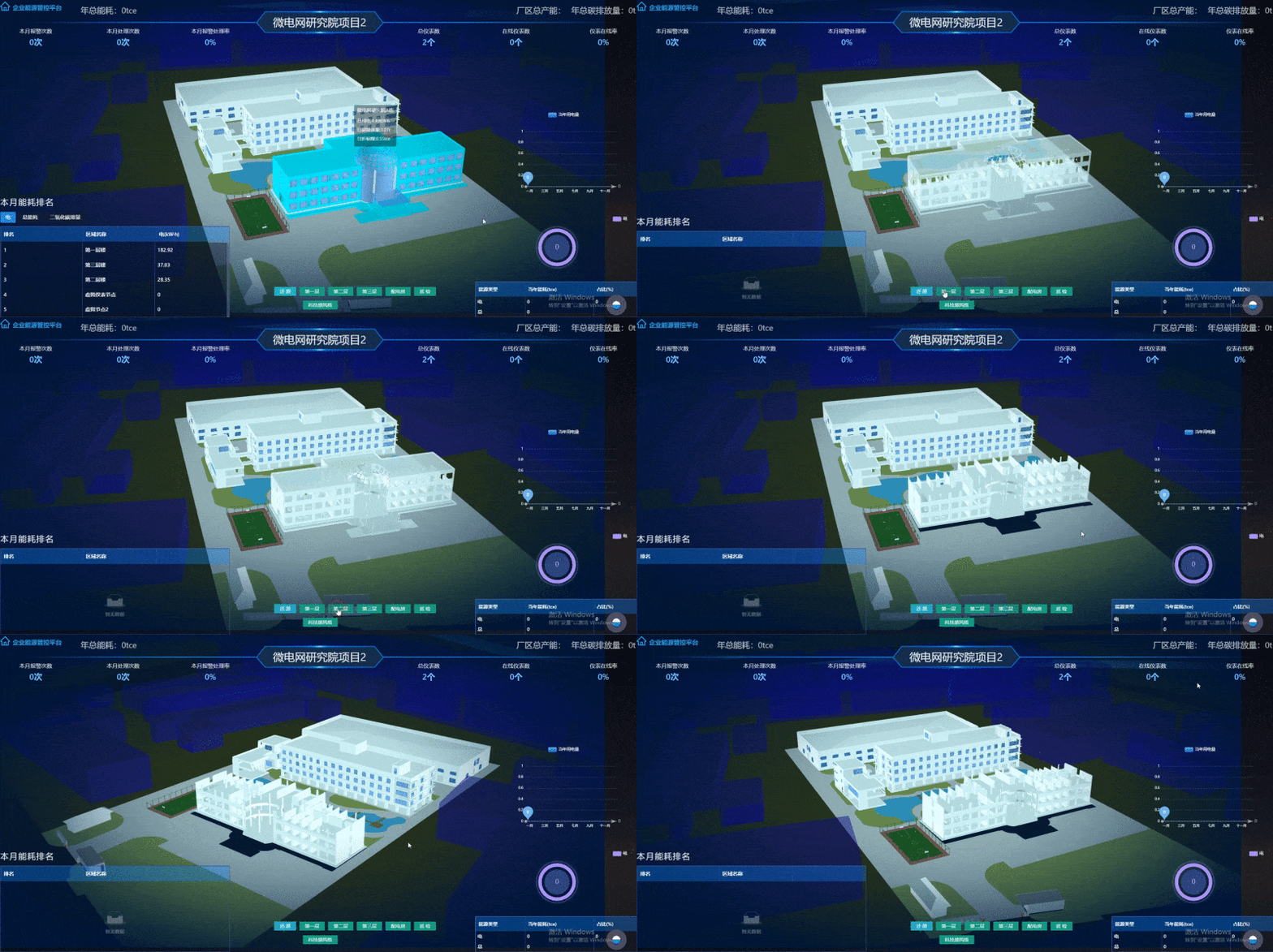
Virtual simulation of the scene, displaying the operation and energy consumption of each area, can achieve layered preview, transition display, style switching, intelligent inspection and other effects, supporting custom binding of models and monitoring points.

8.29 3D subsystem
Virtual simulation of each power subsystem can display the real-time status and energy consumption of the subsystem's power pipelines and equipment, achieving dynamic energy flow effects.

8.30 Industrial Configuration
Customizable configuration diagrams can be created through graphical editing to display device operating status and energy consumption. Custom materials can be uploaded and monitoring data can be bound.

8.31 Custom Cockpit
The cockpit can be customized through graphical operations, displaying collected data and various statistical data in line charts, pie charts, tables, and other graphical formats. Data sources include APIs, database queries, MQTT, Excel, and other methods.

8.32 Basic Data Management
Projects and detectors for the systemEquipment modelelectrical parameterConfigure, modify, delete, and manage nodes, energy, public announcements, and related parametersPerform user addition and authorization management, as well as contract management.

8.33 Mobile APP
The APP supports Android and iOS operating systems, making it convenient for users to grasp enterprise energy consumption, production line comparison, efficiency analysis, same month on month analysis, energy consumption conversion, event recording, operation monitoring, abnormal alarm, distribution diagram, process flow diagram, and energy flow diagram from different dimensions such as energy classification, region, workshop, process, team, and equipment.


8.34 Intellectual Property Certificate


9. System hardware configuration
Application scenarios |
model |
Picture |
protection function |
Enterprise Energy Control Platform |
Acrel-7000 |
|
The Ankerui Enterprise Energy Control Platform adopts automation, information technology, and centralized management mode to implement centralized and flat dynamic monitoring and data management of the production, transmission, distribution, and consumption links of the enterprise, monitoring the consumption of various energy sources such as electricity, water, gas, steam, and compressed air. |
Smart Gateway |
Anet-2E8S1 |
|
8-way RS485 serial port, optocoupler isolation, 2-channel Ethernet interface, supports data access of Modbus Rtu, Modbus TCP, DL/T645-1998, DL/T645-2008, CJT188-2004, OPC UA and other protocols, uploads Modbus TCP (master/slave), 104 (master/slave), building energy consumption, SNMP, MQTT and other protocols, supports forwarding data to multiple platforms with different protocols; Input power supply: AC/DC 220V, rail mounted. |
ANet-2E4SM |
|
4 RS485 serial ports, optocoupler isolation, 2 Ethernet interfaces, support ModbusRtu、ModbusTCP、DL/T645-1998、DL/T645-2008、CJT188-2004、OPC UA、ModbusTCP( Master, slave), 104 (master, slave), building energy consumption SNMP、MQTT; (Main module) Input power supply: DC 12V-36V. Supports 4G expansion module and 485 expansion module. |
|
ANet-485 |
M485 module: 4-channel optocoupler isolated RS485 |
||
ANet-M4G |
M4G module: Supports 4G full network connectivity |
||
35kV/10kV/6kV incoming line |
AM5SE-F |
|
Three stage overcurrent protection, inverse time overcurrent protection, two-stage zero sequence 101 overcurrent/inverse time overcurrent protection, two-stage zero sequence 102 overcurrent/inverse time overcurrent protection, reclosing, rear acceleration overcurrent protection, overload protection, PT disconnection alarm, control circuit fault alarm, frequency protection, FC lockout, voltage loss tripping, reverse power protection, overvoltage protection, zero sequence overvoltage protection; Remote control opening/closing operation of circuit breakers; Fault recording; Independent operating circuit; Check the same period; U. Measurement of electrical parameters such as I, P, Q, Ep, Eq. |
35kV/10kV/6kV 馈线 | |||
distribution transformer |
AM5SE-T |
Three stage overcurrent protection, inverse time overcurrent protection, two-stage zero sequence 101 overcurrent protection, two-stage zero sequence 102 overcurrent protection, 101 inverse time overcurrent protection, 102 inverse time overcurrent protection, overload protection, PT disconnection alarm, control circuit fault alarm, non electric quantity protection, FC lockout; Remote control opening/closing operation of circuit breakers; Fault recording; Independent operating circuit; U. Measurement of electrical parameters such as I, P, Q, Ep, Eq. |
|
Electric motor (below 2000KW) |
AM5SE-M |
Overcurrent protection in the first stage (starting and running), overcurrent protection in the second stage Protection, inverse time overcurrent protection, two-stage negative sequence overcurrent/negative sequence Inverse time overcurrent protection, two-stage zero sequence overcurrent protection, thermal overload protection, overload protection, locked rotor protection, long start time protection, low voltage protection, non electricity protection, PT disconnection alarm, control circuit fault alarm, zero sequence overvoltage alarm, FC lockout, voltage imbalance protection, phase sequence protection, voltage phase failure protection, overvoltage protection; Remote control opening/closing operation of circuit breakers; Fault recording; Independent operating circuit; U、I、P、Q、Ep、 Measurement of electrical parameters such as Eq. |
|
35kV/10kV/6kV bus tie |
AM5SE-B |
Two stage overcurrent protection, inverse time overcurrent protection, post acceleration overcurrent protection, incoming line backup/bus tie backup/joint switch backup/adaptive backup, PT disconnection alarm, control circuit fault alarm, bus charging protection; Remote control opening/closing operation of circuit breakers; Fault recording; Independent operation circuit checks for synchronization. |
|
35KV/10kV/6kV capacitors |
AM5SE-C |
Two stage timed overcurrent protection, inverse time overcurrent protection, two-stage zero sequence overcurrent protection, undervoltage protection, overvoltage protection, zero sequence overvoltage protection, unbalanced voltage protection, unbalanced current protection, non electric quantity protection, PT disconnection alarm, control circuit fault alarm; Remote control opening/closing operation of circuit breakers; Fault recording; Independent operating circuit; U. Measurement of electrical parameters such as I, P, Q, Ep, Eq. |
|
main transformer |
AM5SE-D2 |
Two coil differential quick break protection and ratio braking differential protection |
|
main transformer |
AM5SE-TB |
Three stage overcurrent protection (with composite voltage and directional locking), inverse time overcurrent protection, zero sequence overcurrent protection, gap zero sequence current protection, zero sequence voltage protection, overload protection, starting ventilation, locking on load voltage regulation, circuit breaker remote opening and closing, fault recording, full power measurement, independent operation circuit, remote upshift/downshift/emergency stop, transformer gear measurement; U. 1. Measurement of electrical parameters such as P, Q, Ep, Eq. |
|
PT parallel monitoring |
AM5SE-UB |
|
PT parallel, low voltage alarm, PT disconnection alarm, overvoltage alarm, zero sequence overvoltage alarm |
High power asynchronous motor |
AM5SE-MD |
Motor differential quick break protection, ratio differential protection, overcurrent protection during startup, timed overcurrent protection during operation, overload protection, zero sequence overcurrent protection, overheating protection, locked rotor protection, low voltage protection, remote control of circuit breaker opening and closing, independent operation circuit, fault recording, and full power measurement; U. Measurement of electrical parameters such as I, P, Q, Ep, Eq. |
|
Main transformer protection |
AM5SE-D3 |
Three coil differential quick break protection, ratio braking differential protection |
|
Main transformer common measurement and control, incoming line common measurement and control |
AM5SE-K |
20 channels of remote signaling, 10 channels of output, telemetry |
|
35kV/10kV/6kV arc protection |
ARB5-M |
|
Measure all commonly used power parameters, such as three-phase current, voltage, active and reactive power, kilowatt hours, harmonics, etc., and have complete communication networking functions, which are very suitable for real-time power monitoring systems. |
ARB5-E |
|
DIN35mm rail mounted structure, compact in size, capable of measuring electrical energy and other electrical parameters, and can set parameters such as clock and rate periods. It has high accuracy, good reliability, and performance indicators that meet the technical requirements of national standards GB/T18215-2002, GB/T18883-1999, and power industry standard DL/T614-2008 for electric energy meters. It also has the function of outputting electric energy pulses; RS485 communication interface can be used to exchange data with the upper computer. |
|
ARB5-S |
|
Three phase full power measurement, residual current, 2-63rd harmonic, supports payment rate, measurement value, cable temperature, optional 2G/4G communication. |
|
35kV/10kV/6kV incoming cabinet power quality online monitoring |
APView500 |
|
Phase voltage and current+zero sequence voltage and current, voltage and current imbalance, active and reactive power and electrical energy, event alarms and fault waveform recording, harmonics (voltage/current 63rd harmonic, 50 inter group harmonics, 35 high-order harmonics, harmonic content, harmonic power, harmonic distortion rate, K factor), fluctuations/flicker, voltage rise, voltage drop (fault source location), voltage interruption, impulse current, 1024 point waveform sampling, timed waveform recording, power quality qualification rate statistics, real-time waveform display and fault waveform viewing, 32GB memory, 16DO+22DI, 2RS485+RS232+1GPS,+3 Ethernet interface+1WiFi+1USB interface supports USB data everywhere, supports 61850 protocol. The sentence is:. |
35kV/10kV/6kV interval intelligent control, node temperature measurement |
ASD500 |
|
The LCD screen displays a dynamic simulation diagram of the primary circuit, spring energy storage indication, high-voltage live display and locking, electrical verification, phase verification, 3-channel temperature and humidity control and display, remote/local, opening and closing, energy storage knob, pre opening and pre closing flashing indication, opening and closing intact indication, opening and closing circuit voltage measurement, human body induction, cabinet lighting control, 1-channel Ethernet, 2-channel RS485, 1-channel USB interface, GPS timing, wireless temperature measurement of electrical contacts in the high-voltage cabinet, full electrical parameter temperature measurement, pulse output, 4-20mA output |
35kV/10kV/6kV sensors |
ATE400 |
|
Fixed alloy sheet, CT induction power supply, starting current greater than 5 amperes, temperature measurement range -50-125 ℃, measurement accuracy ± 1 ℃; Transmission distance: 150 meters in open space |
|
35kV/10kV/6kV interval Measurement of electrical parameters |
APM810 |
|
Three phase (I, U, kW, kvar, kWh, kvarh, Hz, cos Φ), zero sequence current In, four quadrant electrical energy, real-time and demand, peak values of this month and last month, current and voltage imbalance, 66 alarm types and 16 external event (SOE) records each, supporting SD card expansion recording, 2-63rd harmonic, 2DI+2DO, RS485/Modbus, LCD display |
low-voltage incoming line |
APM810 |
Three phase (I, U, kW, kvar, kWh, kvarh, Hz, cos Φ), zero sequence current In; four quadrant electrical energy; Real time and demand; Peak of this month and last month; Current and voltage imbalance; Bar chart display of load current; 66 types of alarm and 16 records of external events (SOE), supporting SD card expansion recording; 2-63rd harmonic; 2DI+2DO RS485/Modbus; LCD display |
|
AEM96 |
|
Measurement of three-phase electrical parameters U, I, P, Q, S, PF, F, total positive and negative active energy statistics, and positive and negative reactive energy statistics; Analysis of 2-31st harmonic and total harmonic content, phase harmonics and fundamental electrical parameters (voltage, current, power); Current specification 3 × 1.5 (6) A, active power accuracy of 0.5S level, reactive power accuracy of 2 level |
|
0.4kV reactive power compensation |
ARC |
|
Measure I, U, Hz, cos Φ, with overvoltage protection, undercurrent locking, and protection against excessive harmonics in the power grid. It can control the switching of capacitors and uses RS485/Modbus protocol |
APM810 |
|
Three phase (I, U, kW, kvar, kWh, kvarh, Hz, cos Φ), zero sequence current In, four quadrant electrical energy, real-time and demand, peak values of this month and last month, current and voltage imbalance, 66 alarm types and 16 external event (SOE) records each, supporting SD card expansion recording, 2-63rd harmonic, 2DI+2DO, RS485/Modbus, LCD display |
|
ANSVC |
|
The ANSVC low-voltage reactive power compensation device is connected in parallel throughout the entire power supply system, and can control the switching of power capacitors for compensation based on changes in the load power factor in the power grid. It has multiple compensation forms and can be selected reasonably according to the actual situation of the power grid. |
|
0.4kV active filter |
Ansin - ITO; - M Type I |
|
Adopting DSP+FPGA fully digital control mode, parallel connected in the system, and compensating for harmonics and reactive power; It can provide full compensation for harmonics 2 to 51 or specify specific harmonics for compensation; Equipped with comprehensive bridge arm overcurrent protection, DC overvoltage protection, and device over temperature protection functions; A remote signaling and control software platform built on the Google Fliutter framework, with remote service and data processing functions; Support multi platform interaction on IOS, Android, and PC; Equipped with advanced and lagging power factor correction functions, it can adjust three-phase unbalanced loads to balance; Equipped with dynamic over temperature and load reduction function, ensuring the continuous operation of the filter to the greatest extent possible; Equipped with intelligent fan speed control function, the fan speed is intelligently controlled based on load rate and ambient temperature to reduce losses; Equipped with dynamic expansion function. |
0.4kV outgoing line |
AEM96 |
|
Measurement of three-phase electrical parameters U, I, P, Q, S, PF, F, total positive and negative active energy statistics, and positive and negative reactive energy statistics; Analysis of 2-31st harmonic and total harmonic content, phase harmonics and fundamental electrical parameters (voltage, current, power); Current specification 3 × 1.5 (6) A, active power accuracy of 0.5S level, reactive power accuracy of 2 level |
ARD3M |
|
The ARD3 intelligent motor protector is suitable for motors with rated voltage up to AC690V, rated current up to AC800A, and rated frequency of 50/60Hz. It can form a motor control and protection unit with electrical components such as contactors and motor starters, and has functions such as remote automatic control, on-site direct control, panel indication, signal alarm, and fieldbus communication. |
|
ANHPD300 |
|
It has the ability to absorb random high-order harmonics, pulse spikes, surges, etc. generated by electrical equipment, filter out voltage spike clutter, correct distorted voltage waveforms, digest and absorb harmonic noise, prevent protection devices from tripping incorrectly, and ensure the normal operation of electrical equipment. |
|
DTSD1352 |
|
Measurement of three-phase electrical parameters U, I, P, Q, S, PF, F, statistics of phase wise positive active energy, total positive and negative active energy, and total positive and negative reactive energy; Infrared communication; Current specification: Connected through a transformer to 3 × 1 (6) A, directly connected to 3 × 10 (80) A, active power accuracy of 0.5S level, reactive power accuracy of 2 level |
|
Transformer winding temperature detection |
ARTM-8 |
|
8-way temperature inspection, thermal resistance signal input, RS485 interface, 2-channel relay output, pre embedded PT100 |
|
Transformer joint temperature measurement Temperature measurement of low-voltage inlet and outlet cabinet joints |
ARTM-Pn-E |
|
It can be embedded on the low-voltage cabinet panel, and each device can receive data from 60 wireless sensors. The device is equipped with a 485 interface, which can upload the collected temperature data to the monitoring system. 2-channel alarm exit, full electrical parameter measurement |
ATE400 |
|
Fixed alloy sheet, CT induction power supply, starting current greater than 5 (A), temperature measurement range -50-125 ℃, measurement accuracy ± 1 ℃; Transmission distance: 150 meters in open space |
|
supporting attachments |
AKH-0.66 |
|
Measurement type transformer, collecting AC current signals |
AKH-0.66L |
|
Residual current transformer, collecting residual current signals. |
|
Temperature and humidity inside the cabinet |
AHE |
|
Wireless temperature and humidity sensor, temperature accuracy: ± 1 ℃, humidity accuracy: ± 3% RH, transmission frequency: 5 minutes, transmission distance: 200m, battery life: ≥ 3 years (replaceable) |
ATC600 |
|
Two working modes: terminal and relay. ATC600-Z is used for relay transmission, with a transmission distance of 1000m from ATC600-Z to ATC600-C. ATC600-C can receive data transmitted by AHE, with 1 channel 485 and 2 alarm exits. |
|
Intelligent remote transmission water meter |
IoT water meter LXSY-O-M/NB |
|
Electronic direct reading type, high-definition LCD display, with automatic error correction function; Each parameter can be set; Data can be saved for more than 10 years after power failure; Remote control valve switch function can be expanded as needed; Can work for a long time at 120 ℃, with stable hydrolysis; Strong resistance to acid and alkali corrosion, not easily corroded, and good flame retardant performance; Water resources are protected from secondary pollution |
|
Intelligent remote transmission gas meter |
gas meter |
|
Directly reading the window value of the gas meter without cumulative error; The electronic part may not work normally, but can work instantly when reading the meter; Direct reading of gas meters does not require initialization; The meter address can be flexibly set |
Cold and heat meter |
Cold and heat meter |
|
Flow measurement without mechanical gears or magnetic sensors, wear-resistant, corrosion-resistant, and attack resistant; Automatic alarm when voltage is low or damaged by attack; Automatic alarm when temperature sensor is open or short circuited; Segmented flow and temperature with high accuracy; The cold and hot ends of the temperature are corrected and calibrated using digital methods, with an error close to 0; Intelligent consumption reduction based on flow rate; Multi backup automatic error correction technology for data; low power consumption |


10. Conclusion
This system is based on existing energy consumption data in the mining area and the addition of new energy consumption collection points, combined with a big data analysis platform. With the goal of low-carbon development and guided by the construction of smart mines, a set of energy consumption and carbon emission monitoring systems has been constructed. Fill the gap in data services for on-site energy consumption monitoring, fully tap into the value of massive coal mine data, and play a demonstration role in digital transformation. It conforms to the national plan for the digital transformation and development of coal mines and is a typical case of digital transformation.
At the same time, through a comprehensive energy management system and the use of current data collection technology, energy consumption data from various regions are linked together for comprehensive monitoring, analysis, control, and management. Realize energy conservation and emission reduction, and achieve the national strategic policy goal of "carbon peak" by 2030. Mainly reflected in the following points:
On the basis of connecting to the existing power metering system, the company's electricity consumption is subject to hierarchical supervision according to high energy consuming equipment, important processes, office buildings, and energy consuming units at all levels.
Include the electricity and coal gas consumption of various boilers, as well as the fuel consumption of rubber tired vehicles, in the regulatory system. Although the proportion of water, compressed air, and steam converted into standard coal as energetic working fluids is relatively small, in order to analyze the energy efficiency of systems such as water supply and drainage, compressed air, and boilers, they are also collected and measured.
Monitor the industrial "three wastes" such as coal gangue, mine water, gas, and carbon dioxide generated during the production process, and comprehensively consider the absorption of carbon dioxide by ground greening. Calculate the overall carbon emissions of the mining company.
Build digital energy consumption and carbon emission models for important equipment, important processes, and energy consuming units at all levels, conduct year-on-year, month on month, and benchmarking analysis, and achieve timely warning.
Based on effective output data, construct energy efficiency models for important equipment and processes, analyze equipment operating status, and provide a basis for the economic operation of mining companies.
Utilizing the big data accumulated by the regulatory system to predict the energy consumption, energy efficiency, and carbon emissions of mining companies at more levels, providing reference for management decision-making.